Between the Tours 1968 - 1971
When I left Vietnam at the end of my first tour in October 1968, I was assigned to the United States Army Aviation School at Fort Rucker Alabama. I was given 30 days leave to pick up my family in Rhode Island. They had been living in a small rental house in Pawtucket while I was in Vietnam. After arranging for shipping our furniture to Fort Rucker, we all piled into our new 1968 Ford Country Squire station wagon, which did not have air conditioning. We had three children at that time, two boys and a girl, John, Joan and Jim, ages three to five months old. It was, for my wife Jean and me, a time of high emotion and chaos as we scrambled to move our family to my new duty assignment and to adjust to being back together again.
When I signed into Fort Rucker, I was told to report to the assignments officer, a Lieutenant Colonel in the headquarters building. I was expecting to be assigned to the flight line as an instructor pilot (IP). I hoped that I would be able to build my flight hours and improve my skills as a helicopter pilot. I was in for a big surprise.
Instead of being a flight instructor, I was assigned as a classroom instructor for a new department being formed to teach advanced courses for senior Warrant Officers, the Department of Aviation Warrant Officer Career Development. My protestations against the assignment did not matter, and I was quickly ushered out of the colonel's office with a set of orders in my hand.
Because we had three children and the base housing officer was unable to accommodate us for on-post housing, we were allowed to keep our housing allowance pay and look for a place to live off base. At that time, Fort Rucker Alabama was one of the busiest Army bases in the country as thousands of young aviators flowed in and out of the base either going to Vietnam or returning from a tour in Vietnam.
Jean and I thought we were very fortunate to find a brand new, three-bedroom, ranch style brick house that was available immediately in the town of Ozark, which was a short distance off the base. We were able to buy the house using my Veterans Administration benefits with no money down and a monthly mortgage payment of about $150. We were thrilled. I was also able to purchase a used 1966 Chevrolet Corvair convertible as my work car leaving Jean with the station wagon.
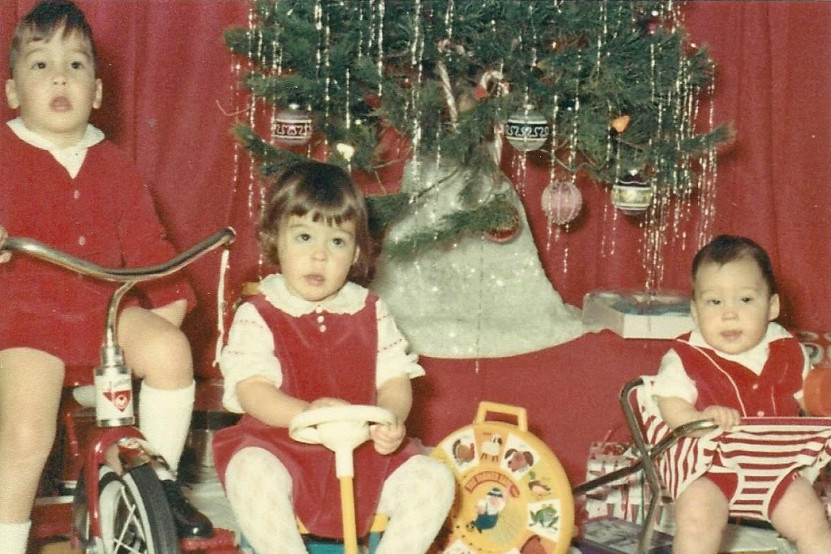
Christmas 1968 in our new house.
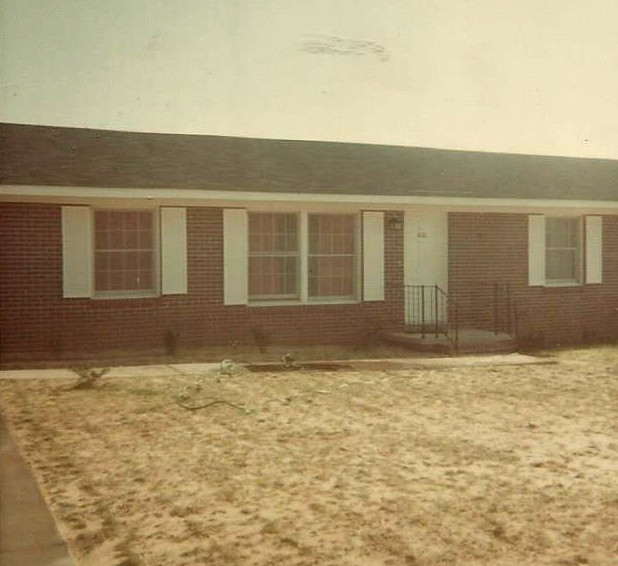
Our brand-new house. Three bedrooms, two baths, a garage, a cement patio and a fenced-in back yard.
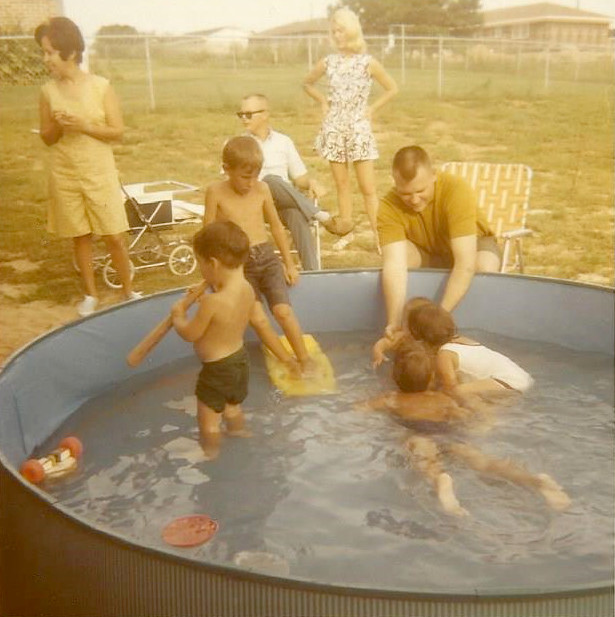
Our children were playing in a back yard pool we had on the patio along with friends (the children of neighbors).
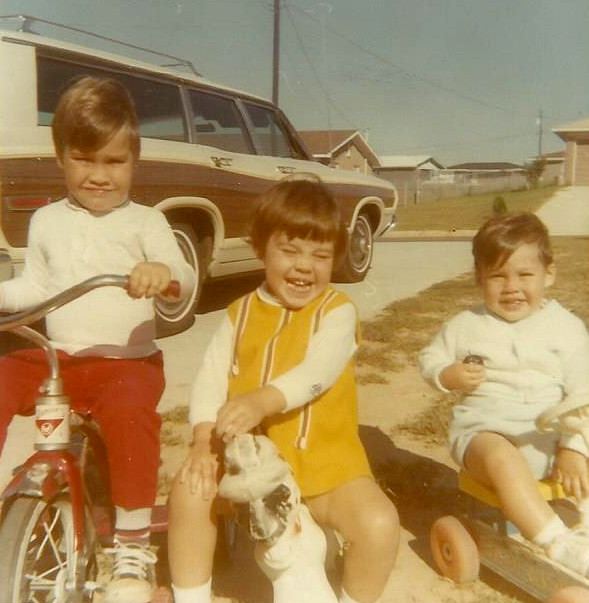
John, Joan, and Jim in the yard of our house in Ozark Alabama.
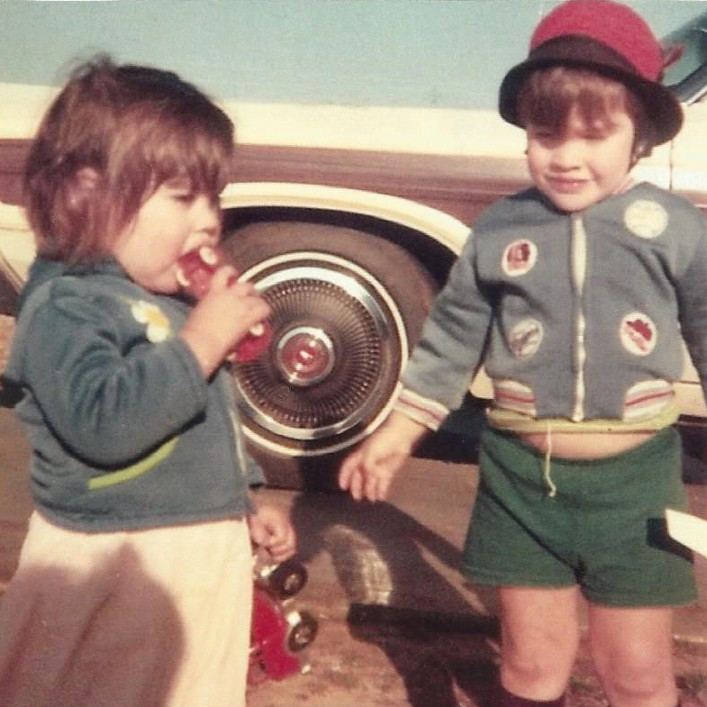
Joanie and John.
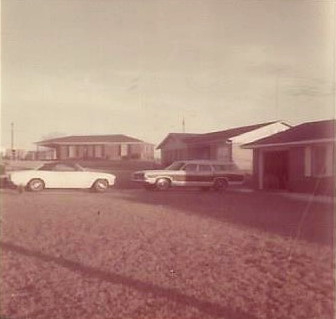
The yellow Corvair and the Country Squire station wagon.
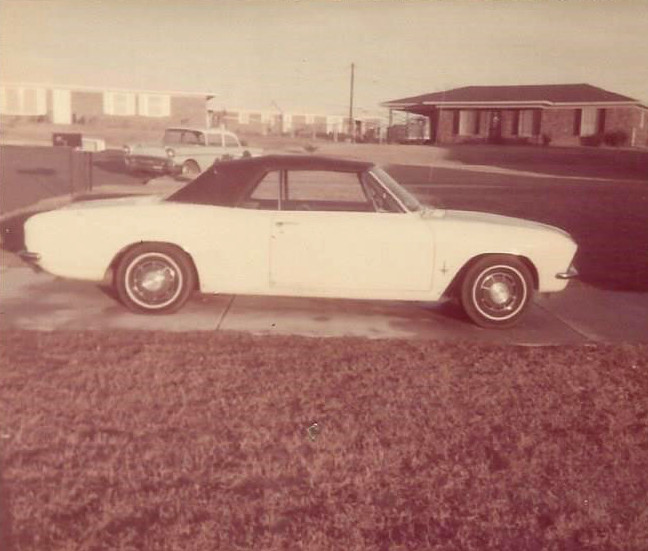
After we were at Fort Rucker for several months, a friend of mine said he traded his 1966 Corvair Monza convertible in at the local Chevy dealership. He told me it was in good shape and that they had allowed him $700 on the trade. I went to the dealership and asked if I could buy the car "as is" for the $700 they had allowed my friend on the trade in. They had not even really looked at the car yet but they agreed and so I was once again driving a Corvair. This was a yellow convertible with a black top and black vinyl interior. It had a three-speed transmission with the shifter on the floor. I was thrilled with the car. It was sporty, fun to drive, and I could put the top down. I knew at that point, to put sand bags in the trunk to hold the front down and to balance the car. It was never a sports car but it was the closest I was going to get for a long time. As a helicopter pilot it met my need to drive something other than a station wagon without breaking the bank. We had to stretch to get it but it made the tour at Fort Rucker much better. Those were hard times in our marriage, and I think the Corvair was a source of some of the stress between Jean and me.
Despite the stress of the new job, new house, and new community, it all seemed to be coming together for us. However, it was not long before all the stress started to catch up to us.
We did not know that returning home from the Vietnam War and adjusting to each other was going to be one of the most difficult times in our marriage. Jean had been making all the decisions for the family for a year. Her life was extremely stressful being alone with three small children and with her husband off at war. She had to cope with it all, and she did so extremely well. She was a very smart, independent minded and strong woman who did not run away from problems but rather took them all head-on. She was a registered nurse and a very capable problem solver. As she often said, there was no one else to turn to, so she had to do it herself. Leaving it all and walking away was never an option for Jean. She knew the meaning of the word duty, and she did her duty every day.
I returned home from the war with a lot of "baggage" in my head. Today people talk about Post Traumatic Stress Disorder or PTSD but back then, we did not know about PTSD and certainly no one talked about it. Many returning veterans dealt with their stress by using alcohol or drugs. Often the internal chaos was hidden by a facade of bravado. I was fortunate that neither alcohol nor drugs were part of my life as a coping mechanism. I thought I was "just fine" and that I could handle whatever stress I had by myself. I did not want to talk about what I was feeling with Jean or anyone else.
It became clear to Jean that this was not the Jack that had gone off to war a year before. She did not recognize this man who appeared to lack any sense of emotion and had difficulty dealing with the normal mess left by three small children and the occasional shouts and screams they made. Loud noises were a problem for me. It seemed, with regard to emotions, I was as "cold as ice."
I learned in combat that the only way for me to deal with the chaos and horror around me was to shut down my emotions and deal with what I faced using just my left brain of cold logic and control. I was afraid to let my emotions control my decision process in any way because I saw others "lose it" when their emotions took over and often their emotion-based decisions were disastrous to themselves and others. Stress was something to be internalized and not allowed to dominate my consciousness.
Adding to my stress was the requirements of my job as a classroom instructor. I had to write 45 hours of lesson plans on such diverse subjects as military justice, ADP (Automatic Data Processing) operations, company administration, and leadership. My writing skills were weak at that point in my life, and my superiors were demanding with very high standards required of me. All of this just added to the stress on our relationship and marriage.
My direct supervisor was Major Eugene A. "Gene" Pawlik who was demanding, with high expectations and standards. After a few months working with him, and having almost all of my written work rejected, I believed I would never achieve the level of performance he demanded. I began to see myself as a failure; and, for the first time in my career, I was seriously thinking of leaving the Army.
Adding to my work stress was a growing awareness of a failing relationship with Jean. At the end of one year, it looked like our marriage, like so many of our friends, was coming apart and could end in separation and divorce. The only thing holding us together was our strong commitment to our children and our Roman Catholic Faith. We did not share our unhappy situation with any of our parents who were living in Rhode Island or any of our other family members. No one knew.
One day, Jean received a call from a distant cousin who asked if we would be willing to have her nephew come by sometime for a visit. She explained that he was a Catholic priest living in Montgomery, Alabama and she thought, since he was alone, it might be nice for him to have some contact with family. She gave Jean Father Knapp's phone number, and Jean agreed to contact him.
Jean and I agreed to offer him a visit but we both realized that, because Montgomery was about 80 miles away, he would probably need to spend the night with us if he was coming for dinner. We expected that he was a young priest who was probably lonely and, as a courtesy to Jean's cousin, we would invite him to spend a weekend with us. When Jean called him, he quickly accepted the invitation, and we agreed to have him come the next weekend.
When Father Knapp arrived the next Friday evening, we were both surprised that he was an older man, probably in his mid-forties. His warm embracing personality quickly put us both at ease. The children also accepted him immediately, kind of like family, and were comfortable with him.
As the evening and conversation unfolded, Jean and I found that he was able to bring up subjects about our relationship that would have been uncomfortable in any other setting. His strong Faith and gentle spirit neither judged nor accused us as we talked through our failing relationship well into the night. His calming presence in our home that weekend was a healing event for both Jean and me. We did not learn, until he was ready to leave, that he was a trained marriage counselor.
As he left us that Sunday afternoon, Jean and I both felt our relationship was mending and that, through our shared Faith, we would come through the storm. As we closed the door when Father Knapp left, I said to Jean, "and He has visited His people." We hugged each other like we had not hugged since I came back from Vietnam.
My work environment also started to improve. I was having more success getting my lesson plans approved, and my writing skills were improving. As classroom instructors at Fort Rucker, we all had to go through a three-week training program called Methods of Instructor or simply MOI. We learned how to use audio visual equipment to improve our instruction and we learned the best methods to communicate our teaching points: how to maintain student attention with eye contact and voice modulation: how to move around the instructor's platform to keep the students engaged: how to use question techniques that would build on the student's knowledge and reinforce our teaching points. It was one of the most valuable courses I took while on active duty, and it gave me presentation skills I have been able to build on throughout my life.
My relationship with Maj. Gene Pawlik continued to improve, and we became best friends. His wife Nancy was a delightful person, and Jean and I would often share a dinner with them either at home or at a local restaurant. That relationship stayed with us for years after we left Fort Rucker.
As our time at Fort Rucker was coming to an end it was clear that a second tour in Vietnam was likely. It was difficult for Jean to think of that so we looked at possible alternatives. Among them was the possibility of leaving the military and going to law school. I agreed to apply to law school and, if accepted, I would leave the Army and follow the path to being a lawyer. We agreed if I did not get accepted into a law school that would be an indicator that we should continue with my military career and take what came along because of that decision. It was a kind of "fleece" and we would trust in the outcome.
It was not long before I learned that I was not accepted at Harvard Law School and that I was on a stand-by list for the University of Connecticut School of Law. With that, the decision was made that we would stay in the Army and that my next likely assignment would be to Fort Benning, George to attend the Infantry Officers Advanced course with a follow-on assignment for my second tour to Vietnam.
There were many memorable and happy times for us during that Fort Rucker assignment. Because the surrounding counties were "dry counties," no alcohol sold, the Fort Rucker Officers Club was a very popular place because it was able to serve alcohol. With the large number of pilots, many of them single, with extra flight pay in their pockets and a sense that they better have fun because they were going back to Vietnam, the Officers Club was a rocking, partying place almost every night. The Club was not supported by any taxpayer money, it had to be a self-sustaining enterprise. At one point, the Club had enough revenue to offer a small Cessna airplane as a prize for the weekly Bingo game.
During that period, many foreign officers from a variety of allied nations attended flight training at Fort Rucker. To help them during their time at the base, the base commander established a Foreign Officer Sponsorship Program. The program allowed American officers and their families at the base to sponsor one or more of these officers. It was a voluntary program that many American officers signed up for. Jean and I decided that we too would sponsor a foreign officer, and we ended up with two Ethiopian Army officers going through helicopter flight training at Fort Rucker. It was an interesting experience for Jean and me and our children, who got to meet these Ethiopian officers. There were several social events scheduled for participants and, on occasion, we would invite our two officers' home for a home cooked meal. They were good men, and we stayed in contact with them long after we left Fort Rucker.
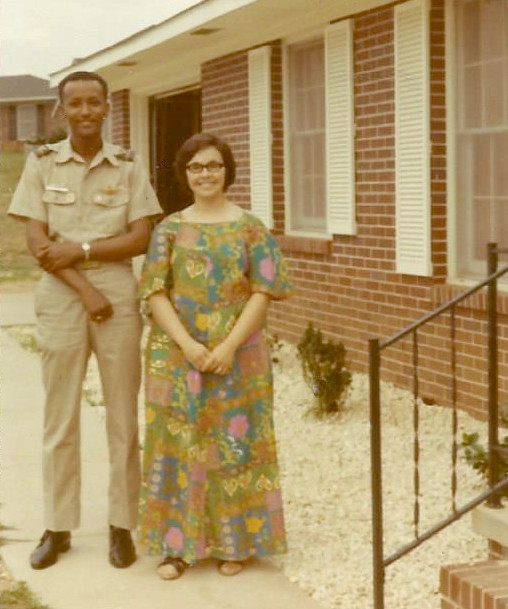
This a picture of Getachew with Jean.
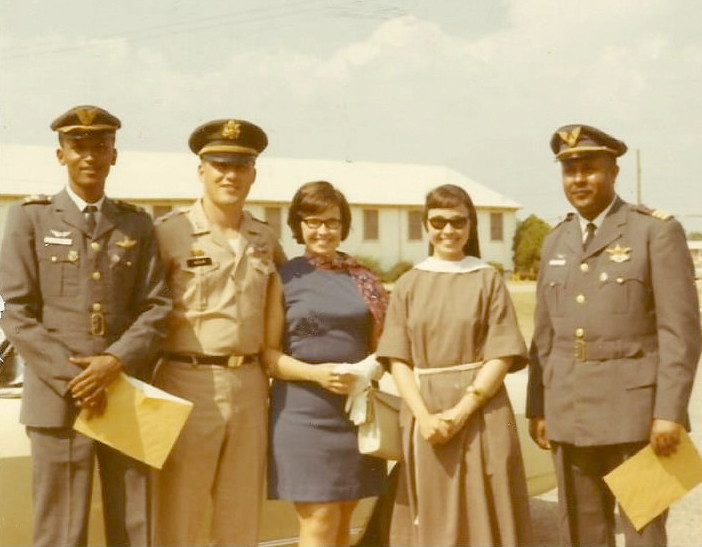
This picture was taken at graduation from flight school. The two Ethiopian Officers were Getachew on the left of the picture and Tefara on the right. Jean's twin sister Joan was a Poor Clare nun who was on her way to Zambia, Africa. She visited with us in Alabama at that time.
After about two years, orders came down on me to attend the Infantry Officers Advanced Course at Fort Benning Georgia, an eleven-month assignment, and we started to prepare for the move. In the meantime, LTC Donald D. "Don" Wilkes, who was one of my superiors, was assigned as a battalion commander for one of the student battalions at Fort Rucker. Jean and I knew LTC Wilkes and his wife Darlene well from my assignment at the Department of Aviation Warrant Officer Career Development and Jean knew Darlene from their volunteer work with the nurses on base.
LTC Wilkes contacted me and asked if I would be willing to take command of one of the student companies under his command, the 31st Student Company. It would be a six-month assignment. I told him I would like to take the command, but I was worried that I might lose my slot for the career course. He assured me that he could have my orders changed and that I would be rescheduled for a later class. Jean and I talked about it and we both agreed that would give us at least another six months before I would have to go back to Vietnam.
It was a good command assignment for me and I appreciated the opportunity. I enjoyed the enlisted soldiers and the officers I had under my command. The six-months flew by and soon we were on our way to Fort Benning Georgia to attend the Advanced Course.
Fort Benning Georgia July 1970 - July 1971
We were given on-post officers' housing in a large duplex located on Sigerfoos Road, near the Commanding General's home. In fact, his yard, with a small goldfish pond, was just behind our house.
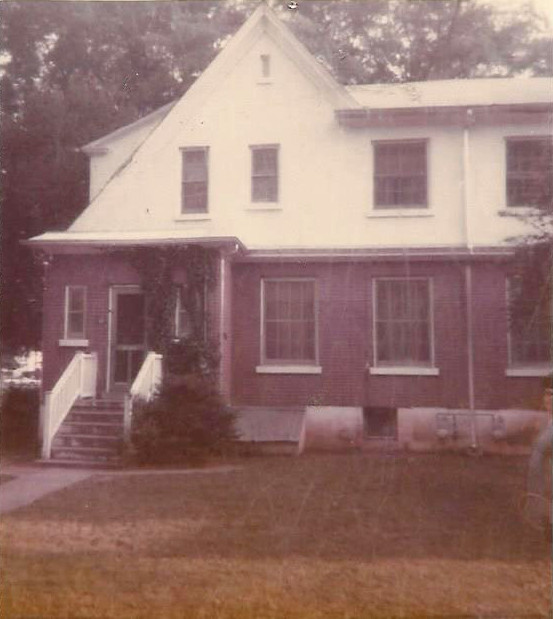
In a funny incident, one day there was a knock at our back door and a young lieutenant, who was the general's aide, was standing there holding our youngest son Jim's hand. Jim was about two and a half years old at the time, and he had been trying to catch the goldfish in the general's little pond. The lieutenant was gracious but he made it clear that it would not be a good idea for Jim to return to the pond. Jim never did.
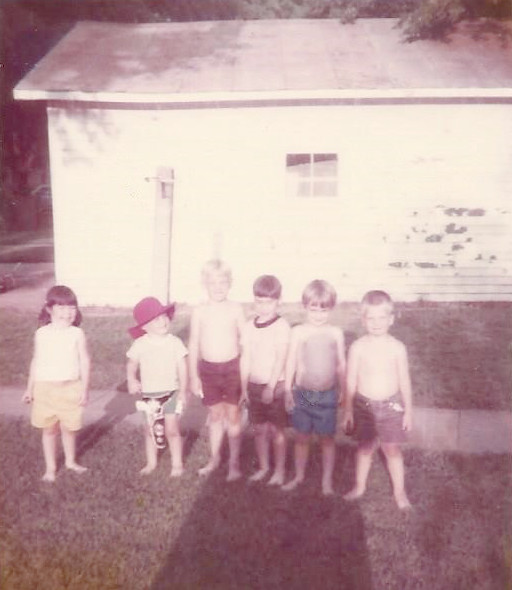
Joan was on the left next to Jim with cowboy hat. John was third from the right.
Most of the military schools I attended were challenging and very organized. Because many of the 190 officers going through the career course in late 1969 knew they would soon be back in Vietnam, there was a more laid-back atmosphere and many of them were more interested in socializing at the club after class than excelling at the academic work of the course. That was understandable. I had a goal however, and I was determined to come out at the top of my class. During the course, we learned that Jean was pregnant with our fourth child and that the birth was likely to coincide with the end date of the course. If I achieved my goal as one of the top ten graduates, I would be guaranteed an additional three weeks at Fort Benning to attend a special course that taught us how to target enemy locations on the battlefield for using atomic weapons. It was called the P-5 course because that was the additional specialty designator I would have on my records. I wanted that extra three weeks so Jean would have the baby at Benning and then we would have time to settle the family back in New England before I had to go back to Vietnam. That was the goal.
At Fort Benning, like Fort Rucker, there was a Foreign Officers Sponsors Program, and we signed up for it. There were 15 foreign offices from allied countries in our class. That included: 3 from Ethiopia, 1 from Lebanon, 2 from Tunisia, 1 from Ecuador and 8 from Vietnam. Usually, the foreign officers sent to the Infantry Officers Career Course were among the best officers from each country. Most were captains and a few were majors. As sponsors, Jean and I were assigned an Ethiopian Army Armor officer, Captain Yilma Ghizaw. He was a little older than we were and intense on achieving his goal of being the first Ethiopian officer to graduate from Infantry Officer Advanced Course as the top allied officer graduate.
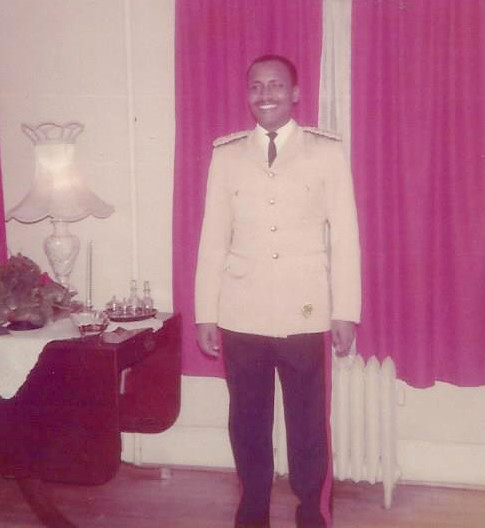
As Yilma's sponsor, he would sit beside me in all our classes. Oftentimes, he did not feel confident in his language skills to ask a question, so he would whisper the question to me and I would ask the question for him. He was very serious about achieving his goal so we established a study group that met most evenings at my home. Those study sessions usually lasted about two hours and I often found myself reteaching some of the course content so Yilma could better understand it. Word spread among my classmates that we were holding these study sessions and several of them asked to join us. I limited the total number to five so that Yilma would not be overwhelmed. Yilma was serious; and, as the group leader, I kept us on task.
On the weekends, there were often events planned, such as local trips or cookouts for the foreign officers and their sponsors. Usually, we could take our children with us, and they benefited from being exposed to the various cultures represented by these officers. Yilma was a dark-skinned African and on one of our trips to a local amusement park I was sitting beside him on the bus. Jean was sitting in the seat in front of us with the children. At one point, our oldest son John, tapped Jean on the shoulder and whispered "Major Yilma is a brown man." Apparently in the months that Yilma had been part of our family he had not become aware of Yilma's skin color. It was never an issue for any of our children to be around people of different ethnic backgrounds.